Binion’s Horseshoe: Where It All Began
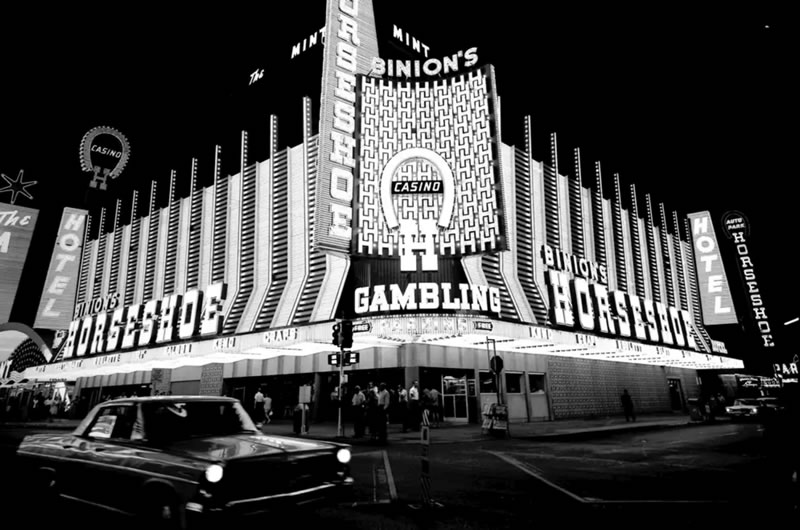
If modern poker had a birthplace, it would undoubtedly be Binion’s Horseshoe. More than just a casino nestled on Fremont Street, in the heart of old Las Vegas, this is where the foundation was laid for what would become the world's greatest poker festival: the World Series of Poker.
A Cowboy’s Dream Turned Legend
It all began in the late 1960s when Benny Binion, a colorful figure in post-war Vegas, decided to organize a unique event: gathering the best cash game players in the country for an open showdown in his own establishment. In 1970, the first WSOP was born in a subdued and confidential atmosphere. No cameras, no sponsors. Just a small circle of living legends: Johnny Moss, Doyle Brunson, Amarillo Slim...
At the time, victory wasn't even decided by elimination: the players voted among themselves to designate the best. It wasn't until 1971 that the tournament adopted the freezeout format, which has since become the standard. The buy-in for the Main Event was $10,000 (about 77 000$ today), a colossal sum reserved for the elite. A format, an atmosphere, a place: the legend was in motion.
The Horseshoe, a Raw Setting for a Pure Game
Binion’s had none of the glitzy allure of the Strip palaces. Here, there were no musical fountains or gilded ceilings. The charm lay elsewhere: worn-out carpets, dark walls, a smoky atmosphere. At the Horseshoe, poker wasn’t a spectacle: it was serious business. Benny Binion often repeated: “Poker is a man’s game, and here, we treat players like kings.”
True to his word, he established a tradition unprecedented for the time: no betting limits in cash games, no rake on high-stakes games, and absolute respect for the poker player, regardless of their profile. An unwritten code of honor that attracted the best and established the Horseshoe as the sanctuary of Texas poker.
Anecdotes, Dramas, and Legends
The Binion’s was the stage for scenes that became mythical. It was here that Stu Ungar, the “Mozart of poker,” triumphed twice in the 1980s before succumbing to his demons. It was here that Doyle Brunson brandished his legendary 10-2 to win two consecutive Main Events. The few but passionate spectators crowded behind the barriers to see these demi-gods in action.
The atmosphere was unique, almost sacred. The Poker Hall of Fame was inaugurated on-site in 1979, hanging on the wall the portraits of those who built the discipline. The clay chips, worn to the bone, became relics. And in the main room, the famous final table, often improvised in a cramped corner, became the stage for an annual epic.
The Turn of the 2000s: A Glory Too Great?
But with the rise of poker, Binion’s began to show its limits. The WSOP, which attracted a few dozen players in the 1970s, now gathered several hundred at the dawn of the 2000s. In 2003, the explosion of the "Moneymaker Effect" propelled the Main Event to over 800 participants... and exposed the inadequacy of the Horseshoe to the growing scale of the phenomenon.
The ESPN cameras, the sponsors, the dealers to train, the necessary gaming spaces: everything became too cramped, too old, too laden with a history that no one dared to modernize. Behind the scenes, the Binion family was shaken by internal struggles. Becky Binion Behnen, who had taken over, struggled to manage the family empire. In 2004, Binion’s was sold. It was the end of an era.
A Last Stand and a Symbolic Farewell
The last WSOP final table at Binion’s took place in 2005. The tournament had already largely moved to the Rio, but the historic final was maintained in the heart of the original room, as a final tribute. Joe Hachem would raise his bracelet where it all began, before the lights went out forever on Fremont Street.
Since then, Binion’s has continued to exist but has never regained its former aura. It remains a place of pilgrimage, a Proustian madeleine for all poker lovers. People go there to breathe in the history, to walk in the footsteps of Moss and Brunson, to see the room where a myth was born.
Binion’s: More Than a Casino, a Sanctuary
The WSOP has since taken on other forms, other places, other colors. But none will ever have that raw, almost sacred, perfume of Binion’s Horseshoe. For it was there, in this modest yet soulful setting, that a simple card game became a part of world culture. It was there that poker ceased to be a saloon vice to become a discipline, an art, a dream.